
Electronic Voting Machine Using 8051 Microcontroller – Project with Circuit Diagram & Source Code
Introduction
An Electronic Voting Machine (EVM) using 8051 microcontroller is a popular and practical electronics project widely used by engineering and diploma students. This project demonstrates how a microcontroller-based system can securely record votes, display results, and reduce human errors associated with traditional paper-based voting systems.
The 8051 microcontroller is ideal for this project due to its simplicity, low cost, and ease of programming. This project is commonly selected as a final year microcontroller project, embedded systems project, or mini project.
What is an Electronic Voting Machine?
An Electronic Voting Machine (EVM) is a digital system that allows voters to cast their votes using electronic buttons instead of paper ballots. Each vote is stored in the memory of the microcontroller and can be counted accurately at the end of the voting process.
In this project, each candidate is assigned a push button. When a voter presses a button, the vote is registered by the 8051 microcontroller and displayed on an LCD screen.
Why Use 8051 Microcontroller for EVM Project?
The 8051 microcontroller is widely used in academic projects because:
Simple architecture and easy programming
Low power consumption
Cost-effective and easily available
Ideal for beginners in embedded systems
Supports LCDs, push buttons, and external memory
Project Objectives
The main objectives of the Electronic Voting Machine using 8051 controller are:
To design a secure electronic voting system
To reduce manual voting errors
To display real-time vote count on LCD
To store vote data safely
To demonstrate embedded system concepts
Block Diagram of Electronic Voting Machine
The block diagram of the project includes:
Power Supply Unit
8051 Microcontroller
Push Buttons (Candidates)
LCD Display (16×2)
Reset Circuit
Crystal Oscillator
Components Required
Below are the main components used in this project:
AT89C51 / AT89S52 (8051 Microcontroller)
16×2 LCD Display
Push Buttons (for candidates)
10k Resistors
Crystal Oscillator (11.0592 MHz)
Capacitors
Power Supply (5V)
Connecting Wires
Breadboard / PCB
Working Principle of Electronic Voting Machine
The working of the Electronic Voting Machine using 8051 microcontroller is simple:
The system initializes the LCD and microcontroller.
Each candidate is assigned a unique push button.
When a voter presses a button, the microcontroller detects the input.
The vote count for that candidate is incremented.
The updated vote count is stored in memory.
Results are displayed on the LCD when required.
This process ensures accurate and tamper-free voting.
Circuit Diagram
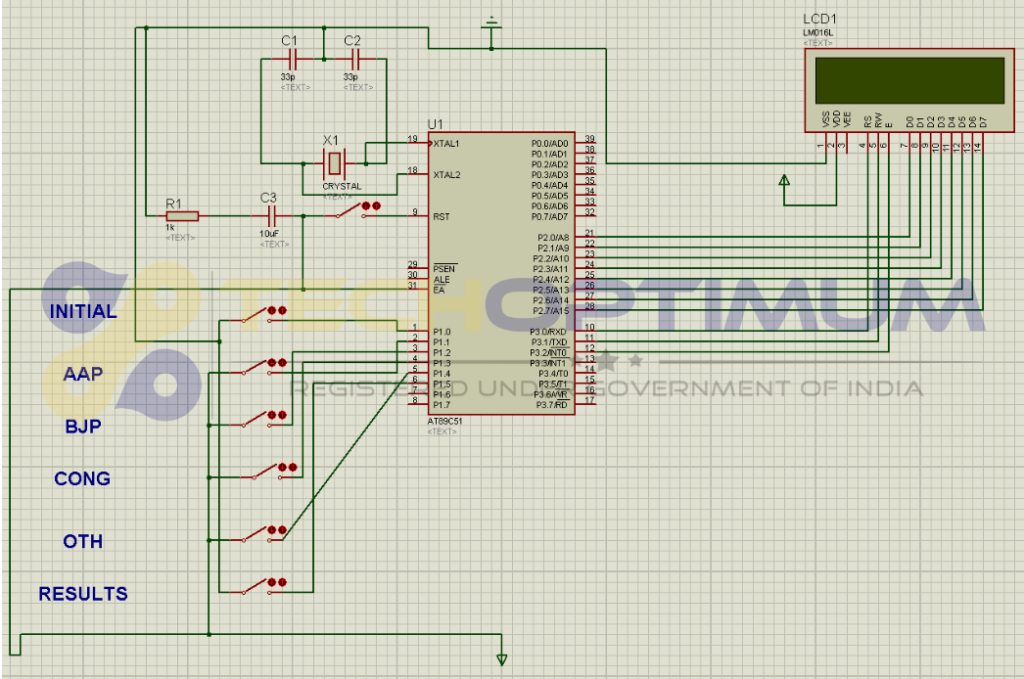
One click away! Download the complete source code & circuit design below.
 Password to open the file:
 Password to open the file:
Tech123 — Loved our work? A small donation means a lot to us

Advantages of Electronic Voting Machine
Faster vote counting
High accuracy
Reduced manpower
Easy to operate
Cost-effective solution
Portable and reliable
Applications of Electronic Voting Machine
College and university elections
Student council voting
Society and club elections
Small-scale government voting simulations
Embedded systems training
Future Scope
The project can be further enhanced by:
Adding fingerprint authentication
Using RFID-based voter identification
Integrating GSM for result transmission
Using EEPROM for long-term data storage
Conclusion
The Electronic Voting Machine using 8051 microcontroller is an excellent project for students learning embedded systems and microcontroller programming. It offers hands-on experience with hardware interfacing, LCD display, and real-time data processing. With proper enhancements, this project can be scaled into a more secure and advanced voting system.



1 Response
[…] […]